

In 2026, the Core Skills Occupation List (CSOL) serves as the key reference for Australia’s employer-sponsored visas. As of 2026, the temporary skilled migration system has been fully updated to prioritise worker mobility and streamline pathways to permanent residency. For global professionals in Mumbai, Melbourne, and across the globe, the Skills in Demand Visa 2026 is now the primary vehicle for entering the Australian workforce and securing an Australia PR visa.
At Bombay Migrations, our MARA-registered agents specialise in these new frameworks. We understand that you aren’t just looking for a job—you are looking for a permanent future. This guide breaks down the transition from the old subclass 482 visa to the new Skills in Demand (SID) system and your guaranteed pathway to PR.
What is the Skills in Demand Visa 2026?
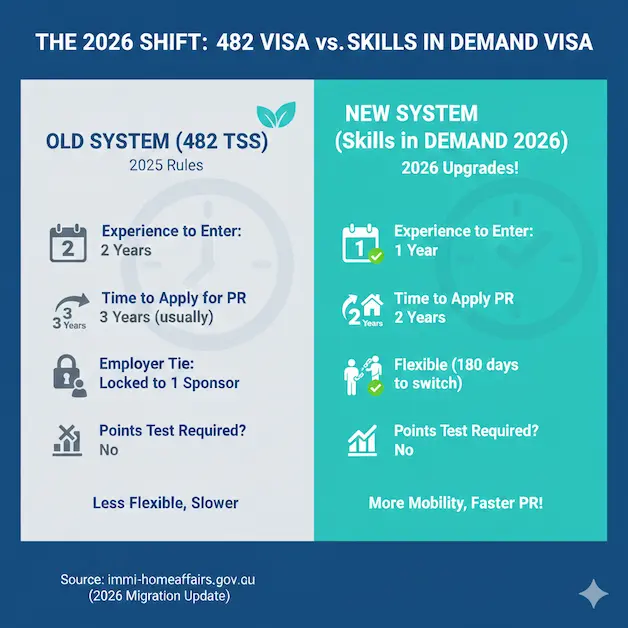
The Skills in Demand Visa 2026 is a four-year temporary skilled worker visa that replaces the previous Temporary Skill Shortage (TSS) framework. It is a strategic shift aimed at attracting global talent by fixing the “employer-lock” problem.
Why it’s a Game-Changer for Global Professionals
• Worker Mobility: Unlike the old 482 visa, you are no longer tied to a single sponsor. You now have 180 days to find a new employer if you leave your current job, and you can work for any approved sponsor during this “grace” period.
• Reduced Experience: You only need 1 year of relevant work experience to apply, a massive reduction from the 2-year requirement of the old system.
• Direct PR Pathway: The wait time to transition to asubclass 186 PR visa is now a clear, shorter path—requiring only two years of work in Australia before nomination.
Unsure if your occupation qualifies for the new one-year experience rule?
The 3-Stream System: Where Do You Fit?
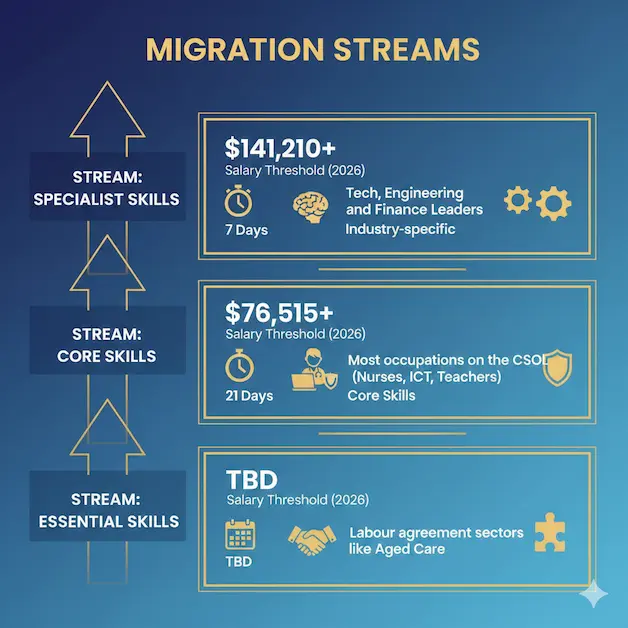
The Skills in Demand Visa 2026 operates on a tiered structure. Your eligibility depends on your occupation and your guaranteed annual earnings.
The 3-Step Pathway to Australia PR 2026
Step 1: Verify Your Occupation on the CSOL
In 2026, the Core Skills Occupation List (CSOL) serves as the key reference for Australia’s employer-sponsored visas… If your job is on this list—which includes over 450 roles in health, education, trades, and tech—you are eligible for the Core Skills stream. Bombay Migrations provides a free preliminary check of the CSOL for all our global clients.
Step 2: Meet the TSMIT 2026 Income Requirements
Your sponsoring employer must pay you at or above the Temporary Skilled Migration Income Threshold (TSMIT). For 2026, the Core Skills Income Threshold is $76,515. Our visa consultant team ensures your contract is compliant with the Annual Market Salary Rate (AMSR) to prevent application refusals.
Step 3: Apply for Subclass 186 (Employer Nomination Scheme)
The final step is the transition to permanent residency. Under the 186 TRT (Temporary Residence Transition) stream, once you have worked in Australia for two years on your SID visa, your employer can nominate you for PR. Because your experience on the SID visa is “portable,” changing employers does not restart your clock for PR eligibility.

Moving from a Student Visa to the Skills in Demand stream?
Strategic Advice for Global Professionals
If you are currently on a student visa 500 or a 485 visa, the Skills in Demand Visa 2026 is your best exit strategy. By moving into an employer-sponsored role, you avoid the extreme competition of the 189 PR visa and 190 PR visa points-based invitations, which often require 95+ points in 2026.
Why Choose Bombay Migrations?
Navigating Australia’s migration services requires a partner who understands both ends of the journey. With a dedicated India Operations Centre in Mumbai and our Head Office in Melbourne, Bombay Migrations offers:
• MARA Registered Expertise: Led by Monalisa Singh, our agents ensure your application complies with the Migration Act 1958.
• Global Reach: We manage applications for professionals worldwide, from the UK and India to Canada and the UAE.
• Success-Driven Strategy: We don’t just “apply for a visa”; we engineer a PR roadmap that covers your skills assessment, state nomination options, and employer sponsorship.
Conclusion: Start Your Journey Today
The Australia PR 2026 quotas are increasingly favouring employer-sponsored workers. The Skills in Demand Visa is the fastest, most flexible way to secure your life in the “Lucky Country.”
Don’t leave your future to chance or outdated advice. Whether you need a visa consultant in Mumbai or a migration agent in Melbourne, Bombay Migrations is here to bridge the gap.